The acronym on everybody's lips these days is HTML. It stands, I recently discovered, for "How To Make Latkes." Hm.
Just kidding, neither of the above sentences are true.
HTML actually stands for HyperText Markup Language; it's a language of letters and symbols and it looks like this:
Which is only a little scary at this point in my life.
This language makes the internet be. The pages we go to every day are built with this code. Each section of code is a marker that acts as a command that provides information that determines how a webpage will look and function. Actually, as I write this post, I'm eyeing a slew of little buttons that can help me add images, videos, and links to my text, as well as buttons that we might consider standard for any contemporary word-processing program. It looks like this:
And this is very useful to me. Because I don't know how to do those things without easy-to-use buttons. But (you'll notice on the left-hand side of the above image) there's a button that will change my entire life. It switches my screen from user-friendly to user-antagonistic. (Kidding.) It allows me to control this blog's output through the use of HTML, which potentially empowers me to do many more complex and interesting things with my blog posts than what I can do with the aforementioned task-bar. Like, right now I feel like I'm ready for a rap battle with Yeezus because I can embed a .gif.

Learning any new language is daunting, but the payoff for learning and understanding it could be pretty significant. The internet is here. It is parallel to, and at certain moments, synonymous with real life. Of what could we be capable if we could speak the language of the internet? If we could recreate or rearrange the building blocks of a website? When literacy in HTML is as prevalent as literacy in spoken language, will the internet just be social media? Will our personal profiles just be our own websites?
Just kidding, neither of the above sentences are true.
HTML actually stands for HyperText Markup Language; it's a language of letters and symbols and it looks like this:
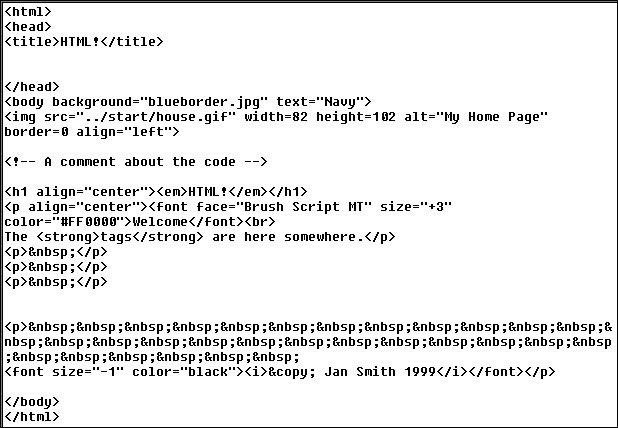 |
| I hope this doesn't translate to something unpleasant. |
Which is only a little scary at this point in my life.
This language makes the internet be. The pages we go to every day are built with this code. Each section of code is a marker that acts as a command that provides information that determines how a webpage will look and function. Actually, as I write this post, I'm eyeing a slew of little buttons that can help me add images, videos, and links to my text, as well as buttons that we might consider standard for any contemporary word-processing program. It looks like this:
 |
| Click me! |
And this is very useful to me. Because I don't know how to do those things without easy-to-use buttons. But (you'll notice on the left-hand side of the above image) there's a button that will change my entire life. It switches my screen from user-friendly to user-antagonistic. (Kidding.) It allows me to control this blog's output through the use of HTML, which potentially empowers me to do many more complex and interesting things with my blog posts than what I can do with the aforementioned task-bar. Like, right now I feel like I'm ready for a rap battle with Yeezus because I can embed a .gif.
Learning any new language is daunting, but the payoff for learning and understanding it could be pretty significant. The internet is here. It is parallel to, and at certain moments, synonymous with real life. Of what could we be capable if we could speak the language of the internet? If we could recreate or rearrange the building blocks of a website? When literacy in HTML is as prevalent as literacy in spoken language, will the internet just be social media? Will our personal profiles just be our own websites?
Comments
Post a Comment